References

Bibliography

Colman, R. (2013, September 5). Leisure in traditional Māori society – ngā mahi a te rēhia – Te whare tapere. Retrieved from Te Ara – the Encyclopedia of New Zealand: https://teara.govt.nz/en/leisure-in-traditional-maori-society-nga-mahi-a-te-rehia/page-4

Gaps between ethnic groups: some key statistics. (2000, June 1). Retrieved from Parliament : https://www.parliament.nz/resource/en-nz/00PLSocRP00101/dd813ed30474d07ed48b8da60257af8bac15a7df

Loader, R. H. (2014, October 22). Waiata tawhito – traditional Māori songs. Retrieved from Te Ara – the Encyclopedia of New Zealand: http://www.TeAra.govt.nz/en/waiata-tawhito-traditional-maori-songs/print

Mitira, T. H. (1972). Takitimu. Wellington: Reed Publishing (NZ) Ltd,.

Rawinia Higgins, A. L. (2014, October 22). Waiata tawhito – traditional Māori songs – Origins of waiata. Retrieved from Te Ara – the Encyclopedia of New Zealand: https://teara.govt.nz/en/waiata-tawhito-traditional-maori-songs/page-2

Smith, V. (2014, October 22). Kapa haka – Māori performing arts. Retrieved from Te Ara – the Encyclopedia of New Zealand: http://www.TeAra.govt.nz/en/kapa-haka-maori-performing-arts


Possible Future

  1. POSSIBLE FUTURES

The possibility for the futures of haka theatre these days are very positive. Making it a normality like kapa haka I think is very likely. Kapa haka is already popular and once there is a doorway to the acting arena that is more accessible to that audience, then we will see a rise in haka theatre making presences in the arts world. A possible future that I would love to see is that it just being theatre and not having that label, I reckon once that happens that’s when we will know that haka theatre has been well normalized.

How to make acting a normal reality in our communities where acting is not common? I believe building bridges and making those connections with the māori world view and the pākehā world view and creating that balance because together we can tell great stories and I also see as it spreading that awareness of doing things with equity and togetherness. Simply, going into the communities and running workshops and making safe spaces to learn and play with the art of acting because their ancestors were great actors and with a bit of guidance I feel will give them a boost forward or a taste of this form of art. By building those connections will give more opportunities to have more māori come into these spaces of the arts where they are not too involved with. Māori theatre is defined as a storytelling art that combines elements of traditional purakau and elements of pakiwaitara which forms the purposes of informal and formal storytelling. We see that kapahaka swings more to the formal aspects of the arts maintain Maori knowledge and Maori genealogy. Additionally, if we can find that bridge to the Haka theatre world then I see that as a great future for Maori performing arts because Haka theatre tends to extend outside the box to a more informal approach which bends the traditions and adds elements within a contemporary setting. Furthermore, this definitely challenges the status quo. We can argue that today’s Kapa Haka and Haka theatre a driven by colonisation which has affect Māori cultures representation in society, but if we can bring awareness and focus to the next generation of storytellers then Māori can keep voicing their stories through the arts with more impact with more audiences with more like minded people. At the end of the day the power of storytelling is unison which is the foundation of kapa haka which can be transferred to haka theatre. Lastly, times are changing already more māori plays are coming to the surface and more māori are slowly making their way to the theatres and also more non māori are finding interest in māori style of theatre which is already a win. Continually, leading to more funding given out for more indigenousness pieces where it gives us that platform to express our views.

Which leaves me with the question as a possible future for Haka theatre what is the next phase?

Evolution

  1. EVOLUTION

Image result for evolution

The 19th Century there was a lot of things going on in terms of politically government trying to exterminate Māori culture and ban our traditions and language. Which, Māori found ways to still perform their traditions such as making tourism groups which you could say were the first kind of Kapa haka. Christian missionaries tried to stop Māori practising their songs and chants. They encouraged Māori to sing hymns and European songs instead. In the 1880s kapa haka groups began performing for tourists, often using European melodies with Māori words. Some concert groups toured overseas. Important visitors such as the British royal family were welcomed with traditional ceremonies, including haka. Kapa haka was also featured at celebrations of Māori organisations such as the Ringatū Church and the Kīngitanga (Māori King movement).

The 20th century saw the welcoming of the waiata a ringa which were modern songs accompanied by guitar as I said before hand. While the First World War was in action Māori leader Sir Āpirana Ngata encouraged kapa haka to raise funds for their Māori Soldiers’. He collected many traditional waiata and speeches.

The 21st century introduces the kapa haka world with more props and out of the box. There is still the use of taking modern tunes and putting it into the items. There are now bigger stages to give the rōpū more space for creativity. We have people bring fire, water, food, non-traditional weapons, and more post-colonial instruments. We have costume changes and more political driven topics. What is different to the old days I would say is the lack of humour in the performances. Back in the early 1980-1990 rōpū were more cheekier and relaxed. Whereas these days kapa haka can be quite proper, sharp, formal and in some ways conservative. As Kapa haka evolves I think it is going to do a U turn and head more back to its traditional origins which were less chaotic and explosive and more simple and straight to the point.

Kapa haka has further evolved into a form of Maori contemporary arts known as Haka Theatre. Haka theatre encompasses Kapa Haka and combines elements of Maori movement, acting and contemporary dance. It is performed in a theatre and has a similar focus and structure as mainstream style theatre swinging towards symbolism and tragedy. Known for today’s form of Haka Theatre that practiced this form is a company called Hawaiki Tu. Their main purpose and messages they hold within their shows are intertwined with “showing Maori in a better light”. Furthermore, arguing that Maori have majority of the negative statistics in the present day (Gaps between ethnic groups: some key statistics, 2000). Hawaiki tu goal is to create a better lifestyle for Maori people, they give them hope to aspire to be proud and embrace their culture.

Image result for hakatheatre

To this present day unitec third year students are doing a form of Haka theatre where they are doing the famous Euripides play the Baccae but in Māori with kapa haka as its base. The times are changing and I cannot wait to see the benefits of haka theatre for the Performing arts industry.

Origins

  1. ORIGINS

My research will be on the whakapapa of Kapa Haka to Haka theatre in New Zealand. If we were to date back the first Kapa Haka performances we have to acknowledge its origins which date back thousands of years back to Māori heritage to their gods. Maori traditions are based on the gods and whakapapa which filter through their story telling. First of all the purpose of this is to maintain cultural identity which links to the importance of knowing where you are from. Additionally, meaning where your ancestors lived, knowing your river, lake, mountain, canoe, ancestral house, and lastly whakapapa. The gods of performing arts are Hineruhi she is a “deity found at dawn, and her dance is said to be the sparkle of light that is reflected in the morning dew” (Rawinia Higgins, 2014). Tanerore the god of light is known to be the heat waves flickering on a hot summer’s day this is recognized as the wiri, “Te haka a Tanerore” the dance of Tanerore (Rawinia Higgins, 2014). Raukatamea (or Hineraukatamea) is the god known for entertainment, and Raukatauri (or Hineraukatauri) is the god of music. Hineraukatauri is personified as the case moth, on which the pūtōrino flute is modelled. Hineraukatauri also is the god of taonga puoro which is Maori traditional flute like instruments made out of greenstone, wood, sea shells, clay and stone. These gods are the foundations of what Māori performing arts are today.
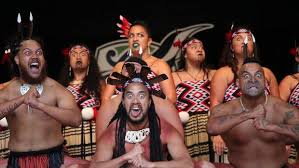
Image result for kapa haka

Items were not commonly performed in massive collections they were rather performed individually. Such as, Haka, waiata tangi, patere, oriori, karakia, pao, ngeri, and the list go on. All these items had specific roles in storytelling which the songs and chants they sung were very real and truthful. Here are some summaries of some few items that embody the performing arts. There is haka which can be performed with weaponry or hand actions which is called a Haka Taparahi. Known as a war dance to intimidate or ambush the enemy. This item remains in the dwell of Tumatauenga(god of war). Waiata tangi is translated ‘a song of sorrow’ which is usually sang on or for mourning occasions such as funerals, memorials, and missing someone you love. Oriori which is a lullaby sung to babies mainly hold messages to encourage the baby to grow up healthy and strong. Patere is a fast beat monotone rhythmic item which discusses events relating to betrayal, war, whakapapa and land. Ngeri are known for short freestyle chants that can be for thanking the chefs for the food or honouring someone.  Pao is a form of freestyle like a form of rap. Post colonisation the introduction of Waiata-a-ringa was formed. The waiata-a-ringa is usually accompanied by a guitar and sung in notes, they can pretty much sing about anything which combines all the previous items. Poi was traditionally used for males to strengthen their wrist for weaponry but also post colonisation it became a female item which they use to show their beauty and femininity.  All of these items are performed in the whare tapere which is the house of entertainment (Mitira, 1972). Other than the meeting house the whare tapere is the main source of storytelling through song, haka, games, and oratory (Colman, 2013).  Which brings us to this day and age; Kapa haka started as tourism type of show which involved 7 items which only 2 hold ancient history which are the moteatea and haka. The other 5 are the waiata tira, whakaeke, waiata a ringa, poi, and whakawatea which are more modern.  First competition recorded was in 1934 on Waitangi Day (Smith, 2014) and then first National competition was in 1972 in Gisbourne which was called the Polynesian Festival. Furthermore, this would be the rise of Kapa Haka.

Image result for pukana

Entry 3 Biculturalism

What’s the Importance of Biculturalism?

Well, it’s the 21st century, this is not the time of black and white. Today’s day an age is constantly been challenged and flipped upside down or downside up. Biculturalism is so bloody important and is something NZ as a whole was struggling with THIS bicultural thing ever since the Tiriti o Waitangi came about. I am glad more and more indigenousness storytellers are coming out of the shadows and not only indigenousness storytellers but storytellers who continue to disrupt the status quo. This is important because NZ is not just full of Kiwi’s. Aotearoa is home to the Māori tangata whenua of this land, but not only that we have Samoan, Tongan, Fijian, Cook island, Indian, Chinese, Japanese, European and the list goes on.

Why is this important?

Well look as a Māori born and raised in the city, I have had the privilege of being brought up in a Māori world and when I have left the comforts of my Māori world I see sadness and anger. Why do I see this? firstly, these stories of the land that these tauiwi a living on having no clue what stories lay beneath their feet. As a Māori I would love to share our stories with the world with Aotearoa and that can only be achieved if more people accept the concept of Biculturalism. I guess as a performing artist it is a goal of mine to challenge the status quo and bring light to stories that are not usually shared and like Todd Karehana and Piata Gardiner-Hoskins I was inspired that they were a part of the many faces challenging the others that Māori can tell better stories such as the violent, drunk drinking, poor, gangs, woman bashing stereotype movies that currently are genres drawn to Māori stories.

TO CHALLENGE THE STATUS QUO IS TO CHALLENGE THE BICULTURALISM IN AOTEAROA.

Entry 2 Safe working.

How to create a safe working environment.

As I mentioned before it is important to make the surrounding of my environment safe to work in. Common sense people! most of the time, well a lot of the time building a safe environment is based on the most simple things. Let’s just reflect over some simple tips of a safe working place. 1) Be Aware Of Your Surroundings, 2) Keep Correct Posture To Protect Your Back, 3) Take Regular Breaks, 4) Use Tools And Machines Properly, 5) Keep Emergency Exits Easily Accessible, 6) Report Unsafe Conditions To Your Supervisor, 7) Use Mechanical Aids Whenever Possible, 8) Stay Sober, 9) Reduce Workplace Stress, and 10) Wear The Correct Safety Equipment.

If you’ll notice these top 10 list of safety procedures are obvious. As I have just finished working on the crucible I noticed that the nights I stayed up way later than the previous night I would struggle to work efficiently at my rehearsals and when I needed to break I asked for it. In these times it is important to communicate.

Communication would be the next big thing that COMES after making sure the workspace is safe. While in the Crucible we were continuously told to yell stop if there were any hazards affecting anyone. Furthermore, there did come a time where a moment came and we did not have to yell stop but one of the scenes water was spilt on the floor and straight away during the set up for the next scene someone came with some wipes and made sure that the mess was sorted. Small things like that make a huge difference because if someone was to leave that, it could put the actors at a huge risk of injuring one’s self and who knows what could happen an actors brain is working 5 billion miles an hour and something small like that could either enhance the performance or destroy it.

Entry one; bullying and harassment

This blog I would like to reflect on the health and safety elements of bullying and harassment. I think it is important to acknowledge that bullying and harassment are apart of health and safety. I would like to explore the question of why bullying and harassment should be an important factor when it comes to working professionally? When I was younger I was a victim too bullying and I did experience these things such as verbal abuse; yelling, using profanities/foul language, spreading a malicious rumour, gossip, or innuendo and intimidating a person – using psychological, physical or emotional forms. From a young age, I understood how much this affects a persons wellbeing and was quick to act on it. As a practitioner in the performing arts, I have not experienced this type of bullying or harassment tactic so far. But the culture that I have been introduced too in drama school weeds out those behaviours and make it clear that that kind of tactics of overpowering someone is unacceptable and has helped build a safe environment for my classmates and tutors. Having the lecture talked about these issues of bullying and harassment realigned the importance of being safe when it comes to making work with colleagues. It is something that I have made sure to be aware of and making sure it is always kept on top of. So the key question of why bullying and harassment should be an important factor when it comes to working professionally is that any workplace or any place at all should be safe and my younger me knew that reaching out to others and talking about it, having support helps create better opportunities to avoid or exterminate those types of behaviours. As an artist, I would take on these teachings and make sure no one would have to experience these types of disgusting behaviour.

Kauri.